How to fold an American flag step by step
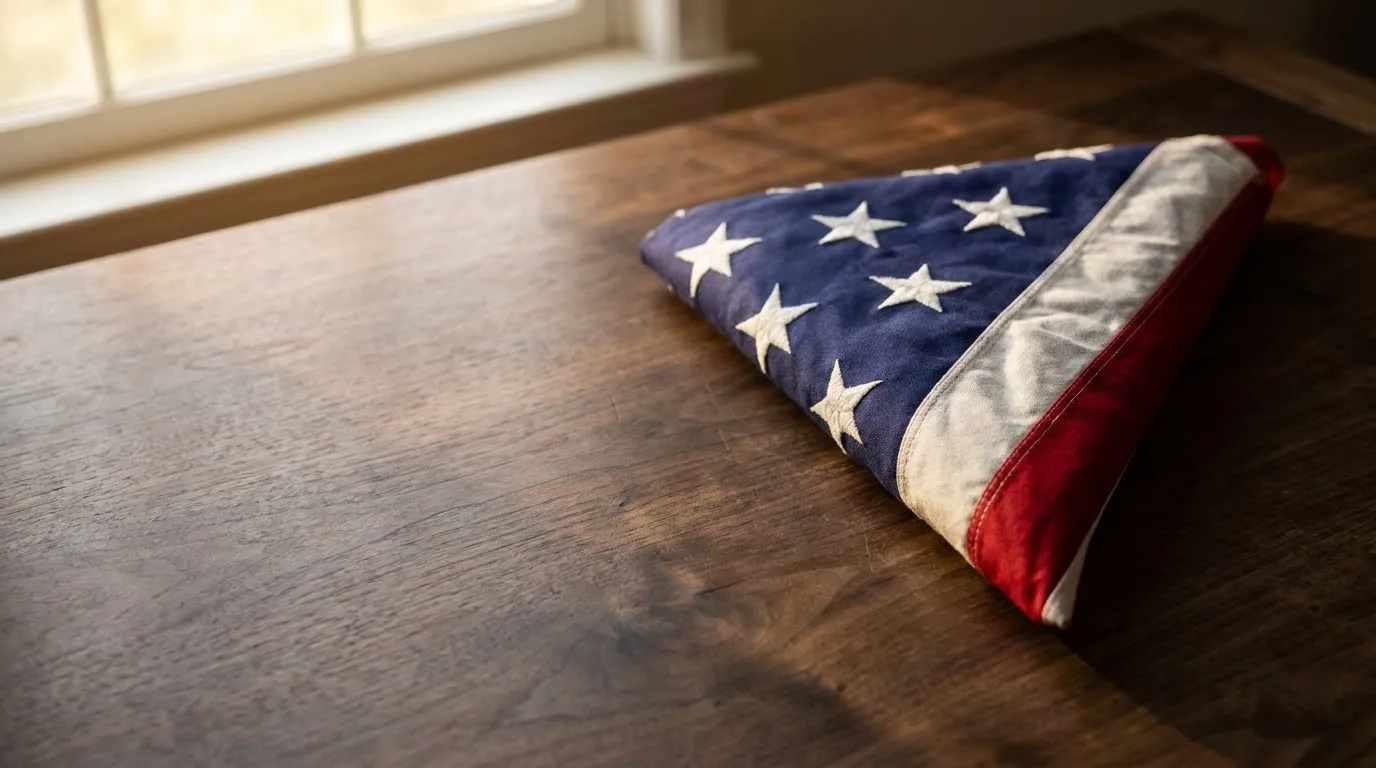
To fold an American flag, two people hold it waist-high and parallel to the ground. Fold the lower striped section lengthwise over the blue union, then fold it lengthwise a second time so the blue starry field stays visible on the outside. Starting at the striped fly end, make 13 tight diagonal triangle folds toward the canton, then tuck the remaining canvas header neatly into the pocket so only stars and blue cloth show.
How to fold an American flag step by step tool
On this page
Why the American flag is folded into a triangle
Across national cemeteries, scout troops, VFW posts, and front porches, lowering the Stars and Stripes at sunset ends with the same quiet choreography. Two people step toward each other, turn a long rectangle of red, white, and blue bunting into a compact three-cornered packet, and tuck the canvas heading out of sight. In our American flag and history learning center, how to fold the flag is one of the most practical skills any citizen can learn.
Unlike many countries that roll or square-fold their national banners for storage, the United States uses a triangular fold that leaves only the blue union and white stars visible on the outside. According to The American Legion, the finished shape is that of a cocked (three-corner) hat, recalling soldiers who served under George Washington and sailors and Marines who served under John Paul Jones. Beyond symbolism, the tight triangle protects the fabric in storage and allows the flag to unfold smoothly without tangling on the halyard the next morning.

Step-by-step: how to fold an American flag
Standard flag-folding ceremonies use two people facing each other at the ends of the flag. Before detaching the grommets from the halyard snaps, make sure you have clear space and a partner ready to take the lower corner so the cloth does not brush the ground, in keeping with U.S. Flag Code rules under 4 U.S.C. § 8(b).
- Hold the flag waist-high and parallel to the ground. Stand facing your partner, one person holding the hoist end (with the blue star field and canvas heading) and the other holding the striped fly end. Pull the fabric gently taut so it does not sag in the middle.
- Make the first lengthwise fold. Fold the lower striped half of the flag lengthwise up over the upper half so the bottom edge meets the top edge cleanly. The person at the hoist end holds the blue canton in their left hand while bringing the red-and-white bottom corner up into their right hand.
- Make the second lengthwise fold. Fold the flag lengthwise a second time, bringing the newly folded bottom edge up to meet the open top edges. Smooth the fabric flat. At this point, the flag is one-quarter of its original width, the folded crease is on the bottom, the open edges are at the top, and the blue field of stars is visible on both outer sides.
- Begin the first triangle fold at the striped end. The person standing at the fly end (opposite the blue union) takes the lower folded corner and brings it up and across to meet the open top edge, forming a right-angle triangle with the outer edge lined up flush against the top.
- Fold the second triangle inward. Turn the outer point of that first triangle straight inward, parallel with the open top edge, to create a second crisp triangle.
- Continue making diagonal triangular folds toward the union. Alternate folding the angled edge across to the top and straight along the length of the strip. Pull each fold snug before creasing the next one; loose early folds will cause the bundle to mushroom before you reach the stars.
- Complete all 13 triangular folds. On a standard government-proportioned flag, 13 alternating folds bring the triangle right up to the edge of the heavy white canvas header at the hoist end, leaving a short tail of blue starry cloth and the grommet strip extending past the triangle.
- Tuck the hoist end into the pocket. Fold the stiff canvas heading down against the flat base of the triangle, then slide the remaining blue flap neatly inside the open pocket created by the last fold.
- Inspect the finished triangle. Every trace of red and white stripe and the white canvas grommet strip should be tucked inside. Only the blue union and white stars should show on both faces of the triangle.
How to count the 13 folds accurately
Guides differ on how folds are counted. Some count the two lengthwise folds as folds one and two, followed by 11 triangular turns, while others treat the lengthwise folds as setup steps and count the triangular turns separately. The VA instructions simply continue the triangular folds until the entire length of the flag is folded.
Why a 3-by-5-foot home flag folds differently
If you practice these steps with a standard hardware-store flag and run out of fabric on fold 10 or 11, you have not folded it wrong. Under Executive Order 10834, signed by President Dwight D. Eisenhower in 1959 when Alaska and Hawaii joined the Union, official government flags have a hoist-to-fly ratio of 1 to 1.9. Flags cut to that ratio, such as the 5-by-9.5-foot federal Size 5, provide more length for the triangular folds.
Most residential flags sold for porch brackets and backyard poles measure 3 feet by 5 feet (a 1 to 1.67 ratio). Because a 3-by-5 flag is proportionally shorter relative to its height, the triangles are wider and consume the length in about 10 or 11 turns. Focus on keeping the triangles tight and the blue star field on the outside rather than forcing extra half-folds.
How to fold a flag by yourself
When taking down a porch flag mounted on a five-foot wooden or aluminum pole, you often do not have a second pair of hands. If the flag stays attached to a wall-mount staff, bring the entire pole indoors rather than trying to unclip the flag in the wind. Once inside, unclip the grommets and lay the flag across a clean bed or dining table. Run through the two lengthwise folds, weight the hoist end lightly with your free hand so it stays aligned, and work the triangular folds from the striped end toward the union.
What the U.S. Flag Code actually says about folding
Many Americans assume that federal law spells out the 13-fold routine down to the inch. In reality, the United States Flag Code, codified in Title 4, Chapter 1 of the United States Code (4 U.S.C. §§ 1–10), does not mention how to fold a flag at all.
What the Flag Code does establish is the standard of care while handling the flag before, during, and after display:
- No contact with the ground (4 U.S.C. § 8(b)): The flag should never touch anything beneath it, such as the ground, the floor, water, or merchandise.
- No storage where it can be damaged (4 U.S.C. § 8(e)): The flag should never be fastened, displayed, used, or stored in a manner that permits it to be easily torn, soiled, or damaged in any way.
- Ceremonious raising and lowering (4 U.S.C. § 6(a) and § 7(m)): The flag should be hoisted briskly and lowered ceremoniously, including when flying the flag at half-staff.
Because the Flag Code uses advisory language (“should” rather than “shall”) and carries no civil or criminal penalties, it functions as the nation’s official rulebook of flag etiquette for civilians. The triangle fold emerged from military drill and naval custom as the cleanest way to satisfy Section 8(b) and Section 8(e): two people holding the flag waist-high keep it well clear of the ground, and the tight triangular packet prevents creases from tearing or soiling in a flag locker.
What about flag clothing while handling the flag?
A related question often comes up during community ceremonies on Flag Day, Memorial Day, or the Fourth of July: does the Flag Code forbid wearing a flag shirt or hat? Two subsections of 4 U.S.C. § 8 address clothing directly:
- 4 U.S.C. § 8(d): States that the flag “should never be used as wearing apparel, bedding, or drapery.”
- 4 U.S.C. § 8(j): States that “no part of the flag should ever be used as a costume or athletic uniform,” while noting that a flag patch may be affixed to the uniform of military personnel, firefighters, police officers, and members of patriotic organizations.
As The American Legion points out in its official flag etiquette interpretations, Congress wrote those lines to stop people from taking an actual, physical U.S. flag and cutting or draping it into a garment. Wearing American flag shirts or embroidered flag hats that display a printed or stitched image of the flag does not violate the Flag Code and is a normal part of civic celebrations across the country.
The traditional meaning of the 13 folds
At military funerals, Scouting courts of honor, and veterans’ ceremonies, a narrator sometimes reads a symbolic meaning for each of the 13 folds as the honor guard works down the length of the flag. It is worth knowing both the history of this reading and what each fold represents.
The American Legion’s folding page mentions a “13-fold flag recitation” that Department of Veterans Affairs volunteer honor guards may read at burials; it is a traditional tribute rather than an act of Congress, and the number 13 is commonly linked to the 13 original colonies. Over the late twentieth century, chaplains and veterans’ posts adopted a standardized ceremonial reading to accompany those 13 movements:
- First fold: A symbol of life.
- Second fold: A symbol of the belief in eternal life.
- Third fold: Made in honor and remembrance of the veterans departing the ranks who gave a portion of their lives for the defense of the country to attain peace throughout the world.
- Fourth fold: Represents our weaker nature, for as American citizens trusting in God, it is to Him we turn in times of peace as well as in times of war for His divine guidance.
- Fifth fold: A tribute to our country.
- Sixth fold: For where our hearts lie, in allegiance to the flag of the United States of America and to the republic for which it stands.
- Seventh fold: A tribute to our Armed Forces, for it is through the Armed Forces that we protect our country and our flag against all her enemies, whether they be found within or without the boundaries of our republic.
- Eighth fold: A tribute to the one who entered into the valley of the shadow of death, that we might see the light of day, and to honor Mother, for whom it flies on Mother’s Day.
- Ninth fold: A tribute to womanhood, for it has been through their faith, love, loyalty, and devotion that the character of the men and women who have made this country great has been molded.
- Tenth fold: A tribute to the father, for he too has given his sons and daughters for the defense of our country since he or she was first born.
- Eleventh fold: In the eyes of a Hebrew citizen, represents the lower portion of the seal of King David and King Solomon, and glorifies in their eyes the God of Abraham, Isaac, and Jacob.
- Twelfth fold: In the eyes of a Christian citizen, represents an emblem of eternity and glorifies, in their eyes, God the Father, the Son, and the Holy Ghost.
- Thirteenth fold: When the flag is completely folded, the stars are uppermost, reminding us of our national motto, “In God We Trust,” adopted by Congress in 1956 (36 U.S.C. § 302).
Note that during official active-duty military funeral honors conducted under Department of Defense instructions, the firing party, bugler, and folding detail work in complete silence; the team leader presents the folded flag to the next of kin using a single prescribed sentence from the service branch on behalf of the President and a grateful nation. The 13-fold narrative is most commonly used at educational demonstrations, retirement ceremonies, and community observances such as Veterans Day.
How to store, display, or retire a folded flag
Once your flag is folded into a firm triangle, how you store it determines how long the nylon or cotton bunting will last.
Storing a working flag between holidays
If you fly your flag primarily on national holidays, store the folded triangle in a dry, climate-controlled closet or drawer away from direct sunlight and attic heat. Avoid sealing a cotton or nylon flag inside an airtight plastic bag if the fabric has any morning dew or humidity trapped in it, as moisture can cause mildew or dye transfer from the red stripes onto the white stars. Breathable acid-free tissue paper or a simple cedar-lined shelf works well.
Placing a burial or commemorative flag in a display case
When placing a folded flag into a triangular wooden and glass shadow box, check the case dimensions before forcing the flag inside. A 5-by-9.5-foot burial flag requires a larger case (typically around 25 inches across the base) than a 3-by-5-foot commemorative flag (which fits a base around 16 to 17 inches wide). Inside the display case, the flat base of the triangle rests on the bottom ledge, the 90-degree peak points straight up, and the white stars sit right-side up facing the viewer.
Retiring a worn flag with dignity
When you fold your flag and notice that the fly end is frayed, torn, or faded beyond repair, 4 U.S.C. § 8(k) states that “the flag, when it is in such condition that it is no longer a fitting emblem for display, should be destroyed in a dignified way, preferably by burning.” Many families fold a worn flag into its final triangle before bringing it to a local American Legion post, VFW hall, or Scouting troop for an annual flag retirement ceremony.
Frequently asked questions
Does the U.S. Flag Code require 13 folds?
No. Title 4 of the United States Code outlines when and how to display the flag and how to treat it with respect, but it does not contain instructions on how to fold it. The 13-fold recitation is a script that Department of Veterans Affairs honor guards may read at burials, and the folding itself is a tradition maintained by veterans' organizations such as The American Legion.
Which side of the flag do you fold first?
For the initial lengthwise fold, bring the bottom striped half up over the top half that contains the blue field of stars. For the second lengthwise fold, bring the folded bottom edge up to meet the top edge again so the blue union is visible on both outsides. When starting the triangular folds, always begin at the striped fly end opposite the stars.
Can one person fold an American flag alone?
Yes, though folding a full-size flag is easiest with two people holding it taut at waist height. If you are lowering and folding a residential flag by yourself, lay the flag flat on a clean, dry surface such as a dining table or bed so it never touches the floor or ground, then execute the same lengthwise and triangular folds.
What if my flag takes more or fewer than 13 folds?
Residential flags often finish in 11 or 12 triangular folds, while large ceremonial or garrison flags may take more. Federal Size 5 flags measure 5 feet by 9.5 feet under Executive Order 10834, a 1:1.9 hoist-to-fly ratio, while a 3-by-5-foot home flag has a wider 3:5 ratio, so finishing with fewer folds is normal.
Are the meanings of the 13 folds part of federal law?
No. The ceremonial script assigning a religious or patriotic meaning to each of the 13 folds is a modern tradition rather than federal law or early military regulation. Honor guards and families frequently read the 13-fold script at military funerals and Flag Day events, but Congress has never codified it in the U.S. Flag Code.
Is it disrespectful to wear an American flag shirt while handling the flag?
Under 4 U.S.C. § 8(d) and § 8(j), an actual flag should never be used as wearing apparel, bedding, drapery, or an athletic costume. The American Legion and etiquette historians explain that these sections forbid cutting or draping a physical flag into clothing, whereas wearing a shirt or hat printed with a flag graphic is widely accepted as patriotic expression.