Complete guide to American flag etiquette and display rules
American flag etiquette provides standardized guidelines for displaying, handling, and honoring the national banner. Codified in Title 4, Chapter 1 of the United States Code, these civilian customs cover proper lighting, respectful positioning on buildings or vehicles, protocols for half-staff mourning, ceremonial folding, and dignified retirement. While advisory and carrying no legal penalties, following these practices expresses gratitude and reverence for the nation and those who served.
Complete guide to American flag etiquette and display rules tool
On this page
Understanding the foundation of American flag etiquette
Flying Old Glory is a cherished tradition across neighborhoods, civic halls, and military installations throughout the country. Proper flag etiquette reflects deep respect for the republic and the generations of Americans who defended its principles. For a complete historical overview of our national banner, visit our American flag history and symbols guide.
The standards governing civilian display are codified in Title 4, Chapter 1 of the United States Code, sections 5 through 10. Originally drafted by representatives of civic and veterans organizations at the National Flag Conferences in 1923 and 1924, these rules were officially adopted by Congress during World War II. For a legal breakdown of how these rules function, review our detailed guide on the U.S. Flag Code.
The Flag Code operates as a guide to voluntary civilian etiquette. It contains no enforcement penalties, criminal fines, or policing mechanisms. Respect for the flag is sustained not through state coercion, but through the informed devotion of American citizens who choose to honor their national standard with precision and dignity.

General rules for outdoor display and building mounts
Title 4, Section 6 of the United States Code outlines the basic conditions under which the American flag should be flown outdoors:
- Hours of display: The custom is to display the flag on buildings and stationary flagstaffs only from sunrise to sunset. However, when a patriotic effect is desired, the flag may be flown twenty-four hours a day if it is properly illuminated during the hours of darkness. A dedicated spotlight or floodlight is the usual way people light a flag during the night.
- Inclement weather: Under 4 U.S.C. § 6(c), the flag should not be displayed during stormy weather, heavy rain, or high winds, unless an all-weather flag is displayed. Modern outdoor flags made from high-strength nylon or woven polyester are designed as all-weather banners and can safely remain aloft through adverse conditions.
- Wall display: Under the Flag Code’s guidance, when the flag is mounted flat against a wall, whether in a horizontal or vertical orientation, the union (the blue field of stars) should be uppermost and to the flag’s own right, which is the observer’s left.
- Display across streets: When suspended over the center of a public street, the flag should hang vertically with the union pointing north on an east-west street, or pointing east on a north-south street.
Displaying the U.S. flag with state, local, and international banners
When the American flag is flown in company with other standards, 4 U.S.C. § 7 provides advisory guidance regarding position and precedence:
- Staffs crossed against a wall: When displayed with another flag with crossed staffs, the Flag Code says the American flag should be on its own right (the viewer’s left), and its staff should be in front of the other staff.
- Group of state, locality, or society flags: When flags of states, cities, or fraternal organizations are grouped on separate staffs, the U.S. flag should be at the center and at the highest point of the group.
- Flown on the same halyard: When flown from the same flagpole as state or municipal banners, the Flag Code says the U.S. flag should always be at the peak, and no other flag or pennant should be placed above the national standard.
- Flags of other sovereign nations: Under the Flag Code’s guidance and international usage, when flags of two or more sovereign nations are displayed, they should be flown from separate staffs of equal height, and the flags should be of approximately equal size, with no nation’s flag placed above another in time of peace.
Half-staff display protocols and national mourning
Flying the flag at half-staff is an official symbol of collective mourning. Under 4 U.S.C. § 7(m), the President of the United States orders flags to half-staff for national officials and figures, while a state or territorial governor (or the Mayor of the District of Columbia) may order half-staff for a present or former official of that state’s own government, for a member of the Armed Forces from that state who dies on active duty, and for a first responder who dies in the line of duty in that state (with federal facilities in that area also flying the flag at half-staff when proclaimed for a fallen service member).
To display the flag at half-staff, the Flag Code’s guidance is as follows:
- Hoisting: When raising the flag to half-staff, the Flag Code says the flag should first be hoisted briskly to the peak for an instant and then lowered slowly to the half-staff position.
- Lowering: At the conclusion of the day, the flag should be hoisted briskly to the peak once more before being lowered for the night.
- Memorial Day observance: On Memorial Day, a unique dual protocol applies. The flag should be displayed at half-staff from sunrise until noon to honor the fallen, and then hoisted briskly to full-staff at noon for the remainder of the day, symbolizing the nation’s endurance.
- House-mounted porch brackets: If your flag is mounted on a fixed-angle porch pole that cannot be lowered to half-staff, the Flag Code itself does not address this situation, though tying a black crepe mourning ribbon or streamer to the staff is a custom some people follow.
Addressing common flag myths: ground contact and cleaning
Several persistent myths circulate regarding flag handling. One widespread misunderstanding holds that if an American flag accidentally touches the ground, it becomes contaminated and has to be immediately burned.
This interpretation is incorrect. Title 4 U.S.C. § 8(b) provides that “the flag should never touch anything beneath it, such as the ground, the floor, water, or merchandise.” This advisory guideline cautions handlers to exercise care during hoisting and folding. If a flag accidentally brushes the lawn or floor, pick it up promptly and inspect it. If the fabric remains clean and undamaged, return it to service immediately. If it has collected dirt, it may be washed gently by hand or dry-cleaned without violating etiquette.
Wearing patriotic apparel with respect
Many Americans enjoy showing their patriotism through everyday clothing, yet questions often arise regarding whether wearing flag-themed shirts or hats violates federal rules. Title 4 U.S.C. § 8 addresses respect for the physical flag in detail:
- Under 4 U.S.C. § 8(d), “the flag should never be used as wearing apparel, bedding, or drapery.”
- Under 4 U.S.C. § 8(j), “no part of the flag should ever be used as a costume or athletic uniform.”
Veterans organizations, including The American Legion, have clarified the practical application of these provisions. The Flag Code addresses the desecration or repurposing of an actual physical flag. Cutting up a cloth flag to manufacture a jacket, vest, or pair of shorts goes against the spirit of the code’s guidance.
By contrast, wearing manufactured patriotic apparel, such as American flag shirts and embroidered American flag hats that feature graphic interpretations of the stars and stripes, is consistent with the Flag Code’s guidance. These garments celebrate national colors and symbols rather than repurposing a consecrated banner, allowing citizens to express patriotic pride with confidence.
Ceremonial folding and dignified flag retirement
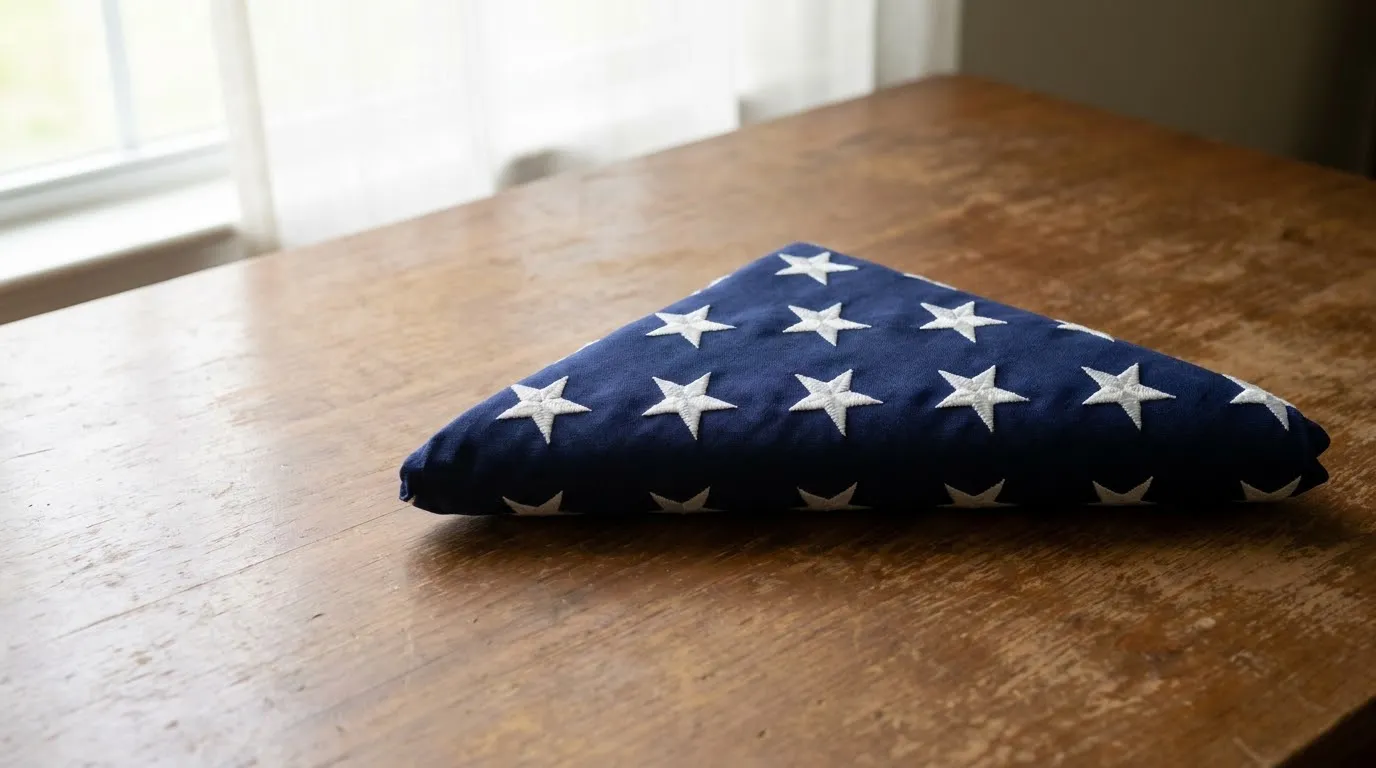
When an American flag is taken down from display, traditional etiquette encourages folding it into a crisp triangular shape:
- Two people hold the flag waist-high, stretching the fabric horizontally.
- Fold the flag in half lengthwise, bringing the lower striped section up over the blue field of stars.
- Fold it lengthwise a second time, ensuring the blue union remains visible on the outside.
- Beginning at the striped end, fold a triangular corner inward toward the open edge.
- Continue making triangular folds along the length of the banner until only the blue field is visible.
- Neatly tuck the remaining fabric into the fold, forming a tight three-cornered package reminiscent of the cocked hats worn by Revolutionary War soldiers.
Under 4 U.S.C. § 8(k), when an American flag reaches the end of its useful life due to severe fading, fraying, or tearing, “it should be destroyed in a dignified way, preferably by burning.” Citizens should not throw an unserviceable flag into ordinary household trash. Most communities feature flag drop boxes at local American Legion posts, Veterans of Foreign Wars halls, municipal buildings, or Boy Scout councils, where veterans conduct dignified retirement ceremonies throughout the year, especially on Flag Day.
Frequently asked questions
Can the American flag be flown at night?
Yes. While 4 U.S.C. § 6(a) states that the universal custom is to display the flag only from sunrise to sunset on buildings and stationary flagstaffs, it advises that the flag may be displayed twenty-four hours a day if properly illuminated during the hours of darkness. A dedicated spotlight or floodlight is the usual way people light a flag at night.
Can the flag be displayed in rain or bad weather?
The flag should not be displayed on days when the weather is inclement, except when an all-weather flag is displayed, according to 4 U.S.C. § 6(c). Modern flags manufactured from durable synthetic materials such as nylon or polyester are specifically engineered as all-weather banners and can withstand rain, wind, and snow without breaching federal etiquette guidelines.
What should you do if an American flag touches the ground?
A common myth suggests that an American flag has to be destroyed if it touches the ground. The Flag Code advises that the flag should not touch anything beneath it, but an accidental drop does not call for retirement. Simply pick up the banner immediately, inspect it for damage, and gently clean it by hand or dry cleaning if soiled before returning it to display.
Is it disrespectful to wear an American flag shirt?
No, wearing commercial apparel printed with flag motifs is not disrespectful. Title 4 U.S.C. § 8(d) states that 'the flag should never be used as wearing apparel,' and § 8(j) provides that 'no part of the flag should ever be used as a costume or athletic uniform.' The American Legion clarifies that these advisory clauses caution against cutting or sewing an actual cloth flag into clothing, not wearing garments decorated with flag artwork.
How is the flag flown at half-staff on Memorial Day?
Under 4 U.S.C. § 7(m), on Memorial Day the flag is displayed at half-staff from sunrise until noon only. At noon, the flag is raised briskly to the top of the staff for the rest of the day until sunset. The morning display honors the service members who gave their lives, while the afternoon display symbolizes the nation's continuing resolve.
How do you properly retire a worn or tattered flag?
Under 4 U.S.C. § 8(k), when a flag is no longer in suitable condition for display, it should be destroyed in a dignified way, preferably by burning. Local posts of The American Legion, Veterans of Foreign Wars, and Boy Scout troops regularly collect unserviceable flags and conduct solemn retirement ceremonies. Separately from the Flag Code's guidance, some communities also offer flag recycling.
What is the proper way to hang the flag vertically on a wall?
When displayed flat against a wall, whether horizontally or vertically, the union (the blue field of stars) should be uppermost and to the flag's own right, which is the observer's left. When hung over the middle of a street, it should be suspended vertically with the union pointing north on an east-west street, or east on a north-south street.