How to display the American flag: official positions and hours
Under Title 4, Sections 6 and 7 of the United States Code, the American flag is customarily displayed from sunrise to sunset, or 24 hours a day if properly illuminated during darkness, using an all-weather flag in inclement weather. Whether flown from a staff, hung flat against a wall or window, or displayed alongside state and international banners, the flag should always occupy the position of honor on its own right (the observer's left).
How to display the American flag: official positions and hours tool
On this page
Federal standards for displaying the American flag
Displaying the Stars and Stripes outside a home, business, or civic hall is one of America’s oldest visual traditions, connecting modern neighborhoods to the historical standards covered in our American flag history and symbols guide. To help citizens display the banner consistently, Congress codified national customs on June 22, 1942, in Title 4, Chapter 1 of the United States Code.
Specifically, 4 U.S.C. § 6 establishes the times, weather conditions, and occasions for flying the flag, while 4 U.S.C. § 7 defines the exact positions for displaying the banner on a staff, flat against a wall, in a window, over a street, and alongside other flags. Together with the courtesy guidelines in Section 8, these statutes form the foundation of everyday flag etiquette.
As explained in our overview of the U.S. Flag Code, Sections 5 through 10 of Title 4 are written as advisory civilian guidelines using the word “should” rather than mandatory criminal statutes. They carry no fines or criminal penalties for private citizens. Observing these rules is a voluntary demonstration of respect that ensures the national emblem always occupies the position of honor.

Hours of display, night illumination, and weather (4 U.S.C. § 6)
Before choosing a mounting bracket or flagpole location, review the basic rules in 4 U.S.C. § 6 governing when the flag should be aloft:
- Sunrise to sunset custom (§ 6(a)): It is the universal custom to display the flag only from sunrise to sunset on buildings and on stationary flagstaffs in the open.
- Twenty-four-hour display and night illumination (§ 6(a)): When a patriotic effect is desired, the flag may be displayed twenty-four hours a day if it is properly illuminated during the hours of darkness. The statute does not specify a fixture type, and The American Legion defines proper illumination as a dedicated light aimed at the flag (preferred) or any light source strong enough for the flag to be clearly visible and recognizable to a casual observer.
- Manner of hoisting and lowering (§ 6(b)): The flag should always be hoisted briskly and lowered ceremoniously, never allowed to trail across the ground or porch steps as it comes down.
- Inclement weather and all-weather flags (§ 6(c)): The code states that the flag should not be displayed on days when the weather is inclement, except when an all-weather flag is displayed. Traditional cotton or wool bunting flags absorb moisture, become heavy in rain, and tear easily in wet gusts. Modern outdoor flags made of durable nylon or two-ply spun polyester are designed as all-weather banners and can remain flying during ordinary rain or snow, though taking any flag down ahead of hurricane-force winds or ice storms will greatly extend its lifespan.
- Holidays and special occasions (§ 6(d)): While citizens are encouraged to fly the flag every day, Section 6(d) specifically calls for display on national and state holidays, including Fourth of July, Memorial Day (half-staff until noon), Flag Day on June 14, and Veterans Day on November 11.
Displaying the flag flat on a wall or in a window (4 U.S.C. § 7(i))
One of the most common mistakes in civilian display happens when hanging a flag flat against a wall, garage door, or window without a flagpole. In heraldry and military tradition, the blue field of stars—called the union—is the point of honor, and the flag’s “own right” corresponds to the observer’s left when facing the banner.
Under 4 U.S.C. § 7(i), whenever the flag is displayed other than by being flown from a staff, it should be displayed flat, whether indoors or outdoors, never draped or gathered into folds:
- Horizontally on a wall: Hang the flag flat with the blue union uppermost and to the flag’s own right, which is the viewer’s upper left.
- Vertically on a wall: Hang the flag flat with the blue union uppermost and still to the viewer’s upper left. Note that if you take a horizontally hung flag and simply rotate it 90 degrees clockwise to hang it vertically, the stars will end up in the upper-right corner—which is backwards. Instead, rotate the flag and flip it so the canvas header and blue union remain on the upper-left side from the observer’s perspective.
- In a window: When hanging a flag inside a window, 4 U.S.C. § 7(i) directs that it should be displayed the same way—with the blue field to the left of the observer in the street. When you stand inside your living room looking at the window, the stars will be on your upper right so that neighbors and passersby outside see the union in the upper-left position of honor.
For decorating railings, speaker tables, or porch banisters where pleated fabric is desired, 4 U.S.C. § 8(e) states that you should never drape an actual flag over a railing or table. Instead, use red, white, and blue bunting, arranged with the blue stripe at the top (representing the union), white in the middle, and red at the bottom.
Suspending the flag over a street (4 U.S.C. § 7(j))
During civic parades, homecoming weeks, and patriotic holidays, towns sometimes suspend a large American flag vertically over the middle of a main thoroughfare between buildings or utility poles. Because pedestrians and drivers approach a street-hung banner from two opposite directions, “observer’s left” changes depending on which way traffic is moving.
To remove any ambiguity, 4 U.S.C. § 7(j) establishes a fixed compass rule when suspending a flag vertically over the middle of a street:
- On an east-and-west street: The blue union should face north (so the stars are on the north side of the street).
- On a north-and-south street: The blue union should face east (so the stars are on the east side of the street).
The statute also notes in 4 U.S.C. § 8(c) that the flag should never be carried flat or horizontally, but always aloft and free, except as may be necessary in limited circumstances and done in a respectful manner as part of a military or patriotic observance.
Displaying the flag from a staff, porch bracket, or vehicle
Most homeowners and businesses fly the American flag from a freestanding pole or an angled bracket mounted to a porch column, window sill, or building facade. Section 7 provides clear directions for every staff configuration:
Projecting from a building or porch (4 U.S.C. § 7(h))
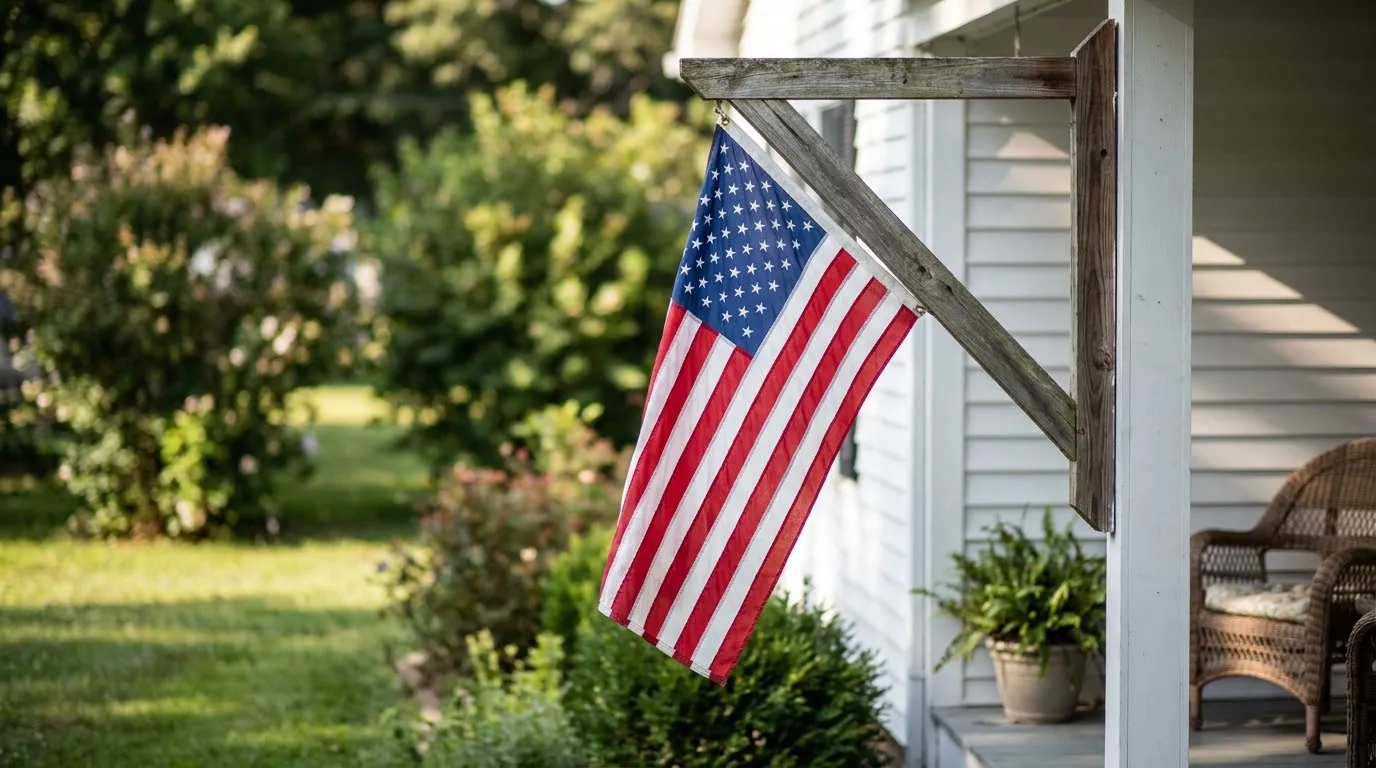
When the flag is displayed from a staff projecting horizontally or at an upward angle from a window sill, balcony, or the front of a building, 4 U.S.C. § 7(h) states that the union of the flag should be placed at the peak of the staff (the end farthest from the building), unless the flag is flown at half-staff. Make sure the bracket is mounted where the fly end of the flag can wave freely without snagging on gutters, shutters, or thorny shrubs.
On a speaker’s platform or inside an auditorium (4 U.S.C. § 7(k))
When displayed on a speaker’s platform or from a staff in a church, school auditorium, or public meeting hall under 4 U.S.C. § 7(k):
- Displayed flat on a speaker’s platform: If displayed flat rather than from a staff, the flag should be displayed above and behind the speaker.
- Displayed from a staff in a church or public auditorium: The flag of the United States should hold the position of superior prominence, in advance of the audience, and in the position of honor at the clergyman’s or speaker’s right as they face the audience (which is the audience’s left), whether on a platform or at floor level. Any other flag so displayed should be placed on the left of the clergyman or speaker or to the right of the audience.
On a parade float or motor vehicle (4 U.S.C. § 7(a) and (b))
Under 4 U.S.C. § 7(a), a flag on a parade float should always be flown from a staff or hung flat against a surface as provided in subsection (i). Under 4 U.S.C. § 7(b), the flag should never be draped over the hood, top, sides, or back of a car, truck, train, or boat. When displayed on a motorcar, the staff should be fixed firmly to the chassis or clamped to the right fender (the passenger side in the United States).
Flying at half-staff (4 U.S.C. § 7(m))
When national or state mourning is proclaimed, 4 U.S.C. § 7(m) instructs that the flag should first be hoisted briskly to the peak of the pole for an instant and then lowered slowly to the half-staff position (one-half the distance between the top and bottom of the staff). Before lowering the flag for the day, it should be raised to the peak again. For complete rules on who can issue a proclamation and how to handle fixed porch poles that cannot slide down, see our guide on flying the flag at half-staff.
Displaying the U.S. flag with other flags (4 U.S.C. § 7(c)–(g))
Whenever the American flag is displayed alongside state flags, municipal banners, organizational pennants, or flags of other nations, 4 U.S.C. § 7(c) sets the fundamental rule: no other flag or pennant should be placed above the U.S. flag or, if on the same level, to the U.S. flag’s own right (the observer’s left). The only narrow statutory exceptions in § 7(c) are church pennants flown by naval chaplains during services at sea and the United Nations headquarters complex.
Here is how that principle applies to every multi-flag arrangement under Section 7:
- Same flagpole / halyard (§ 7(f)): When a state flag, city flag, or POW/MIA banner flies on the same rope beneath the U.S. flag, the American flag should always be at the very peak. Any second flag flies directly below it and should be of equal or smaller dimensions so it does not visually overshadow the national standard.
- Two crossed staffs against a wall (§ 7(d)): When crossed with another flag against a wall, the U.S. flag should be on its own right (the observer’s left), and its staff should be in front of the other flag’s staff.
- Two or more adjacent flagpoles of equal height (§ 7(c) and (f)): When flown on separate poles in a straight line of equal height, the U.S. flag occupies the far-left pole from the observer’s viewpoint (its own right). The U.S. flag should always be hoisted first and lowered last.
- Group or semicircle of state and local flags (§ 7(e)): When a number of state, municipal, or society flags are grouped and displayed from staffs—such as an angled fan mount or a semicircle of poles in front of a courthouse with a taller center pole—the U.S. flag should be at the center and at the highest point of the group.
- Marching in a procession (§ 7 introductory clause): When carried in a parade or color guard with other flags, the U.S. flag should be either on the marching right (the right-hand side of the marching line from the marchers’ perspective) or, if there is a line of other flags, in front of the center of that line.
- With flags of other sovereign nations (§ 7(g)): When flags of two or more nations are displayed together, they should be flown from separate staffs of the same height, and the flags should be of approximately equal size. International custom forbids displaying the flag of one nation above that of another nation in time of peace. In the United States, the U.S. flag takes the position of honor on its own right (the observer’s far left), followed by the other nations’ flags in alphabetical order in English.
Respect for the flag and patriotic clothing (4 U.S.C. § 8)
Alongside proper positioning, Title 4, Section 8 outlines essential rules of respect: the flag should never be displayed with the union down except as a signal of dire distress in instances of extreme danger to life or property (§ 8(a)), should never touch anything beneath it (§ 8(b)), and should never have marks, letters, or drawings placed directly upon it (§ 8(g)).
Readers frequently wonder how 4 U.S.C. § 8(d) (“the flag should never be used as wearing apparel, bedding, or drapery”) and 4 U.S.C. § 8(j) (“no part of the flag should ever be used as a costume or athletic uniform”) apply to everyday clothing. The American Legion explains that these clauses prohibit taking an actual cloth flag designed to fly from a staff and cutting or tailoring it into a garment or costume. Wearing purpose-made American flag shirts and embroidered American flag hats that feature graphic designs of the Stars and Stripes is a respectful, time-tested way to celebrate American heritage.
Frequently asked questions
Which way do the stars face when hanging an American flag on a wall?
Under 4 U.S.C. § 7(i), whether you hang the American flag horizontally or vertically flat against a wall, the union (the blue field of white stars) should always be at the top and to the flag's own right, which is the observer's left. When shifting a flag from horizontal to vertical display, do not simply rotate it clockwise; you should also flip it over so the blue field remains in the upper-left corner facing the viewer.
How do you display an American flag in a window?
According to 4 U.S.C. § 7(i), when displaying the American flag in a window, you should hang it with the blue union at the top and to the left of the observer who is standing outside on the street looking at the building. From inside your home or office, the stars will appear in the upper-right corner because the display is oriented to honor the view of passersby outdoors.
Can I leave my American flag up at night?
Yes, provided it is illuminated. Under 4 U.S.C. § 6(a), the universal custom is to display the flag only from sunrise to sunset on buildings and stationary flagstaffs in the open. However, when a patriotic effect is desired, the flag may be displayed twenty-four hours a day if it is properly illuminated during the hours of darkness by a dedicated light aimed at the flag or another light source strong enough for the flag to be clearly visible and recognizable.
Can the American flag be flown in the rain or snow?
Under 4 U.S.C. § 6(c), the flag should not be displayed on days when the weather is inclement, except when an all-weather flag is displayed. Most modern outdoor flags made from woven nylon or spun polyester are engineered as all-weather flags and can stay up during rain or light snow. Traditional cotton flags and delicate heirloom banners should be brought indoors before storms arrive.
Which side does the American flag go on when displayed with a state flag?
When flown on the same halyard (rope), 4 U.S.C. § 7(f) states that the U.S. flag should always be at the peak above the state flag. When flown from two adjacent poles of equal height, 4 U.S.C. § 7(c) and (f) specify that the U.S. flag goes on its own right (the viewer's left), and it should be hoisted first and lowered last.
How should an American flag be hung vertically over a street?
Under 4 U.S.C. § 7(j), when the American flag is suspended over the middle of a street rather than flown from a pole, it should be hung vertically with the blue union facing north on an east-and-west street, or with the blue union facing east on a north-and-south street. It should hang high enough to clear passing traffic safely.
Is it against the Flag Code to wear an American flag shirt?
No. Title 4, Section 8(d) states that 'the flag should never be used as wearing apparel, bedding, or drapery,' and Section 8(j) states that 'no part of the flag should ever be used as a costume or athletic uniform.' As The American Legion clarifies, these rules prohibit cutting or sewing an actual physical flag into clothing, whereas wearing commercially printed or embroidered flag apparel is an accepted way to show patriotism.