National POW/MIA Recognition Day: 2027 Date, Flag Law, and Observance
National POW/MIA Recognition Day is observed annually on the third Friday in September to honor American service members who were held as prisoners of war and those who remain missing in action from past conflicts. In 2027, the observance falls on Friday, September 17. Federal law under Title 36, Section 902 of the United States Code governs the official display of the black-and-white POW/MIA flag alongside the United States flag at major federal sites.
National POW/MIA Recognition Day: 2027 Date, Flag Law, and Observance tool
On this page
What National POW/MIA Recognition Day honors
Among the solemn observances on the calendar of patriotic holidays, National POW/MIA Recognition Day holds a distinct and deeply personal place for military families and veterans across the United States. Observed every year on the third Friday in September, the day honors two groups of American service members: those who were captured and held as prisoners of war in service to the nation, and those who remain missing in action and unaccounted for from past conflicts.
Unlike holidays that mark the conclusion of a specific war or the signing of a founding document, National POW/MIA Recognition Day centers on an ongoing national promise. It affirms that the United States does not leave its defenders behind on the battlefield and that federal recovery and identification teams continue working around the globe until every possible service member is returned home to their family.
According to the Defense POW/MIA Accounting Agency (DPAA), more than 81,000 Americans remain missing from World War II, the Korean War, the Vietnam War, the Cold War, the Gulf Wars, and other conflicts. Roughly 75 percent of those unaccounted-for losses occurred in the Indo-Pacific theater, primarily during World War II, and more than 41,000 of the missing are presumed lost at sea. Each September, the Pentagon, military installations, veterans service organizations, and local communities pause to recognize the endurance of former prisoners of war and the steadfast advocacy of families awaiting answers.

Origins of the observance and the third Friday in September
The movement to establish a national day recognizing prisoners of war and missing personnel grew out of the Vietnam War. During the late 1960s and early 1970s, wives, parents, and siblings of captured and missing American aviators and ground troops organized the National League of Families of American Prisoners and Missing in Southeast Asia. Even after Operation Homecoming brought 591 American prisoners of war home in the spring of 1973, thousands of families still had no confirmed accounting of their loved ones.
In August 1978, the 95th Congress passed a joint resolution (Public Law 95-349) authorizing the President to proclaim July 18, 1979, as the first National POW/MIA Recognition Day. President Jimmy Carter signed Proclamation 4664 on June 4, 1979, calling upon all Americans to join in honoring those who suffered captivity and those whose fate remained unresolved. The inaugural national ceremony took place at the Washington National Cathedral and featured a Missing Man formation flyover by the 1st Tactical Fighter Wing from Langley Air Force Base.
During the early 1980s, Congress and the President designated dates in July or April for the annual observance. To establish a consistent annual schedule that was not tied to the anniversary of any single war, the National League of POW/MIA Families advocated for the third Friday in September. Beginning in 1986 under President Ronald Reagan, the third Friday in September became the permanent annual date for National POW/MIA Recognition Day, proclaimed each year by the President of the United States.
Dates for 2027 and how the day is scheduled
Because National POW/MIA Recognition Day is anchored to the third Friday in September rather than a fixed calendar number, the exact date shifts slightly each year between September 15 and September 21.
Following the 2026 observance on Friday, September 18, 2026, the next observance date is:
- 2027 Date: Friday, September 17, 2027 (the third Friday of September 2027).
National POW/MIA Recognition Day is a federally recognized observance proclaimed annually by the President, rather than a legal public holiday for federal employee time off under Title 5, Section 6103 of the United States Code. Federal offices, post offices, schools, and financial markets remain open, while the Department of Defense, the Defense POW/MIA Accounting Agency, and veterans organizations conduct formal commemorative ceremonies throughout the day.
The national ceremony traditionally takes place at the Pentagon river parade field or a major national memorial, attended by senior defense leaders, former prisoners of war, and family members of the missing. Each year, DPAA also releases an official commemorative poster reflecting the ongoing mission to fulfill the nation’s promise.
History and symbolism of the POW/MIA flag
The visual centerpiece of National POW/MIA Recognition Day is the black-and-white National League of Families POW/MIA flag. Its origin traces to 1970 and 1971, when Mary Helen Hoff, the wife of U.S. Navy Lieutenant Commander Michael G. Hoff (whose aircraft was lost over Laos on January 7, 1970), recognized the need for an unmistakable symbol to keep prisoners of war and missing service members in the public eye.
Mrs. Hoff contacted Norman Rivkees, vice president of the historic flag manufacturer Annin & Company, who arranged for graphic designer Newton Heisley to create a design. Heisley had served as a World War II Army Air Forces transport pilot in the Pacific theater and understood firsthand the fear of being shot down and forgotten. While sketching the flag in 1971, Heisley drew inspiration from the gaunt facial profile of his 24-year-old son, Jeffrey, who was recovering from a severe bout of hepatitis contracted during Marine Corps training.
The resulting black-and-white emblem carries specific symbolism in every detail:
- The Black Background: Represents the solemnity of captivity and the sorrow of families awaiting word of missing loved ones.
- The Bowed Silhouette: Depicts a prisoner of war in profile, reflecting both physical hardship and quiet dignity.
- The Watchtower and Barbed Wire: Appear behind the silhouette in the upper right of the central white disk, symbolizing grim captivity under armed guard.
- The Black-and-White Wreath: Frames the lower half of the central disk as a tribute to valor and endurance.
- The Motto: Beneath the emblem stand the words “You Are Not Forgotten,” expressing the core pledge of the American people to every missing service member.
The National League of Families formally approved the design in January 1972 and chose not to copyright or trademark the emblem so that citizens, veterans posts, and civic groups could reproduce and fly it freely across the nation.
36 U.S.C. 902 and federal POW/MIA flag display days
Congress codified the status and display requirements of the POW/MIA flag in Title 36, Section 902 of the United States Code. First enacted on August 10, 1990, by Public Law 101-355 (104 Stat. 416) and codified into 36 U.S.C. 902(a) in 1998 by Public Law 105-225, Section 902(a) officially designates the National League of Families POW/MIA flag as “the symbol of our Nation’s concern and commitment to resolving as fully as possible the fates of Americans still prisoner, missing, and unaccounted for in Southeast Asia, thus ending the uncertainty for their families and the Nation.”
From six annual display days to year-round display
When Congress expanded federal POW/MIA flag display requirements in Section 1082 of the National Defense Authorization Act for Fiscal Year 1998 (Public Law 105-85, enacted November 18, 1997, and codified in 36 U.S.C. 902(b)–(g) by Public Law 105-354), subsection (c) mandated that designated federal properties display the POW/MIA flag on six specific national observances each year:
- Armed Forces Day (third Saturday in May)
- Memorial Day (last Monday in May)
- Flag Day (June 14)
- Independence Day (July 4)
- National POW/MIA Recognition Day (third Friday in September)
- Veterans Day (November 11)
While those six days remain major civic focal points for state, municipal, and residential observances, federal law expanded significantly in 2019. On November 7, 2019, the National POW/MIA Flag Act (Public Law 116-67) amended 36 U.S.C. 902(c) to read simply: “For the purposes of this section, POW/MIA flag display days are all days on which the flag of the United States is displayed.”
Locations required to display the flag under 36 U.S.C. 902(d)
Under subsection (d) of the statute, the POW/MIA flag must be displayed every day the American flag flies at the following federal locations:
- The United States Capitol (where the flag also stands on permanent display inside the Capitol Rotunda)
- The White House
- The World War II Memorial, the Korean War Veterans Memorial, and the Vietnam Veterans Memorial on the National Mall
- Every national cemetery
- The buildings containing the official offices of the Secretary of State, the Secretary of Defense, the Secretary of Veterans Affairs, and the Director of the Selective Service System
- Every major military installation, as designated by the Secretary of Defense
- Every Department of Veterans Affairs medical center
- Every United States Postal Service post office
Subsection (f) of 36 U.S.C. 902 further directs that display of the POW/MIA flag at these locations shall be in a manner designed to ensure visibility to the public. A statutory note under Pub. L. 107-323, section 2(c), adds that the 2002 amendments may not be construed as requiring a new or additional flagpole.
How to fly the POW/MIA flag below the United States flag
Homeowners, businesses, and veterans posts frequently fly the POW/MIA flag on National POW/MIA Recognition Day and throughout the year. Proper placement is governed by the interaction between 36 U.S.C. 902 and the United States Flag Code under 4 U.S.C. 7.
Flying on the same flagpole
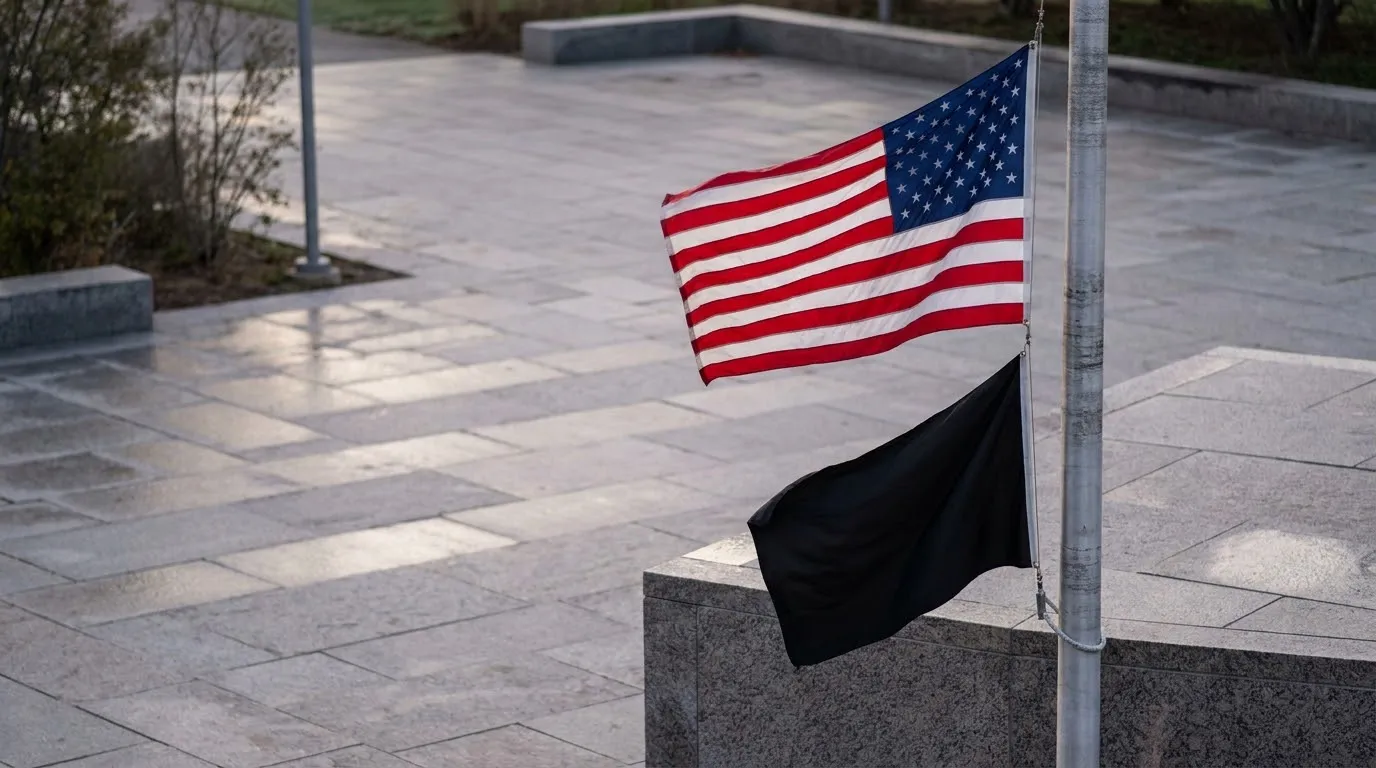
When displaying the POW/MIA flag on the same flagpole halyard as the United States flag, a common arrangement is to fly the POW/MIA flag immediately below the flag of the United States. Federal law does not set a precedence rule for civilian flagpoles beyond the Flag Code’s advice that no other flag should be placed above the U.S. flag. If a state flag is also flown on the same pole, a common arrangement from top to bottom is:
- The flag of the United States at the peak of the staff
- The POW/MIA flag directly beneath the United States flag
- The state flag beneath the POW/MIA flag, if one is flown
To keep the display balanced and prevent excessive strain on the halyard, the POW/MIA flag should be the same size as, or slightly smaller than, the United States flag flying above it.
Flying on separate flagpoles
When displaying flags on two adjacent flagpoles of equal height, the United States flag should be flown on the pole to the flag’s own right (which is the observer’s left when facing the building or display), and the POW/MIA flag is flown on the pole to the observer’s right. Under the advisory U.S. Flag Code, 4 U.S.C. 7(c), no other flag or pennant should be placed above the flag of the United States. The United States flag should always be hoisted first and lowered last. For additional residential display guidance, read our complete guide on flag etiquette.
Half-staff protocol when both flags are flown
National POW/MIA Recognition Day itself is a full-staff observance unless a separate half-staff proclamation is in effect. Whenever the United States flag is lowered to half-staff on a pole that also carries the POW/MIA flag, both banners are hoisted briskly to the peak for an instant and then lowered together to the half-staff position. If the POW/MIA flag flies on an adjacent pole, it should also be lowered to half-staff so that it never flies higher than the United States flag.
How communities and military posts observe the day
Across the country, National POW/MIA Recognition Day is marked by solemn ceremonies that keep the focus on individual service members and their families:
- The Missing Man Table Ceremony: Military dining halls, VFW and American Legion posts, and civic gatherings set a small round table draped in white cloth at a place of honor. During the ceremony, a narrator explains the meaning of each item on the table: the white cloth for pure intentions in answering the nation’s call, the single red rose in a vase tied with a yellow or red ribbon for family love and faith awaiting their return, the slice of lemon on the bread plate for the bitter fate of those captured or missing, the pinch of salt for the tears of waiting families, the inverted glass because the missing comrade cannot toast with the gathering, and the empty chair because they are not present.
- Reading of Names and Candlelight Vigils: State capitols and war memorials hold 24-hour name readings and evening candlelight vigils reading the roster of service members from that state who remain unaccounted for.
- DPAA Identification Briefings: Throughout the year and leading up to the third Friday in September, the Defense POW/MIA Accounting Agency conducts family member updates across the country, sharing forensic anthropology, mitochondrial DNA, and historical archival breakthroughs that continue to identify hundreds of missing service members each year.
Respectful attire for POW/MIA ceremonies
Attending a National POW/MIA Recognition Day ceremony, candlelight vigil, or memorial service calls for quiet, dignified attire that reflects respect for former prisoners of war and Gold Star and MIA families.
If you choose to wear patriotic clothing to a community observance or veterans hall gathering, understated options work best:
- Dark and Neutral Tones: Navy, black, charcoal, and heather gray shirts suit the solemn character of the day.
- Classic Flag Apparel: Our American flag shirts, crafted on soft ring-spun cotton and heavyweight garment-dyed tees, and our low-profile embroidered American flag hats offer clean, respectful styling without loud slogans.
By flying the POW/MIA flag beneath the Stars and Stripes, learning the history of the more than 81,000 Americans still unaccounted for, and observing the third Friday in September on September 17, 2027, citizens help ensure that the promise “You Are Not Forgotten” endures across generations.
Frequently asked questions
When is National POW/MIA Recognition Day in 2027?
National POW/MIA Recognition Day is observed on the third Friday in September every year. In 2027, the observance takes place on Friday, September 17, 2027. Unlike many military observances tied to the anniversary of a single battle or armistice, the third Friday in September was chosen by the National League of POW/MIA Families and Congress so the day stands apart from specific war anniversaries and honors missing personnel from every conflict.
What does the POW/MIA flag represent and who designed it?
The POW/MIA flag represents America's solemn commitment to achieving the fullest possible accounting of prisoners of war and missing service members. Graphic designer and former World War II pilot Newton Heisley designed the emblem in 1971 after Navy wife Mary Helen Hoff proposed a national symbol for the National League of Families. The design shows a gaunt silhouette before a watchtower and barbed wire above the motto "You Are Not Forgotten."
What are the required display days for the POW/MIA flag under 36 U.S.C. 902?
Under Title 36, Section 902(c) of the United States Code, as amended by the National POW/MIA Flag Act of 2019, POW/MIA flag display days are all days on which the flag of the United States is displayed. Before November 2019, the statute required federal locations to fly the banner on six annual observances: Armed Forces Day, Memorial Day, Flag Day, Independence Day, National POW/MIA Recognition Day, and Veterans Day.
How should the POW/MIA flag be flown with the American flag?
When flown from the same flagpole as the United States flag, the customary placement is for the POW/MIA flag to be flown immediately below the American flag. Under the advisory U.S. Flag Code, 4 U.S.C. 7(c), no other flag or pennant should be placed above the flag of the United States. If displayed on separate adjacent flagpoles of equal height, the American flag occupies the position of honor on its own right (the observer's left).
Which federal locations are required by law to fly the POW/MIA flag?
Title 36, Section 902(d) requires the POW/MIA flag to be displayed at the U.S. Capitol, the White House, the World War II Memorial, the Korean War Veterans Memorial, the Vietnam Veterans Memorial, every national cemetery, the buildings housing the offices of the Secretaries of State, Defense, and Veterans Affairs and the Selective Service Director, major military installations, VA medical centers, and every United States Postal Service post office.
What is the Missing Man Table ceremony held on POW/MIA Recognition Day?
The Missing Man Table, also called the Fallen Comrade Table, is a solemn ceremonial setting displayed at military dining facilities and civic events on National POW/MIA Recognition Day. Set for one person, the small round table includes a white tablecloth, a single red rose, a slice of lemon, grains of salt, an inverted glass, a lit candle, and an empty chair symbolizing service members who cannot be present.
Sources
- Defense POW/MIA Accounting Agency (DPAA) - Mission and History
- 36 U.S.C. 902 - National League of Families POW/MIA Flag
- Public Law 116-67 - National POW/MIA Flag Act of 2019
- The American Presidency Project - Proclamation 4664, National POW-MIA Recognition Day, 1979
- 4 U.S.C. 7 - Position and Manner of Display