Juneteenth National Independence Day History, General Order No. 3, and 2027 Observance
Juneteenth National Independence Day is a federal legal holiday observed annually on June 19 to commemorate the end of slavery in the United States. It marks June 19, 1865, when Union Major General Gordon Granger issued General Order No. 3 announcing that enslaved people in Texas were free. Codified under 5 U.S.C. § 6103 in 2021, Juneteenth in 2027 falls on Saturday, June 19, with federal observance on Friday, June 18.
Juneteenth National Independence Day History, General Order No. 3, and 2027 Observance tool
On this page
What Juneteenth Commemorates in American History
On the calendar of American patriotic holidays, Juneteenth National Independence Day honors one of the defining milestones in the history of constitutional liberty: the enforcement of emancipation in the final reaches of the Confederacy at the close of the Civil War.
Celebrated annually on June 19, the name “Juneteenth” blends the words “June” and “nineteenth.” Historically referred to as Jubilee Day, Emancipation Day, and Freedom Day, the holiday marks June 19, 1865, when Union Major General Gordon Granger, who had arrived in Galveston, Texas, the previous day at the head of roughly two thousand federal troops, took command of the Department of Texas and enforced the authority of the United States Government.
Although the Declaration of Independence proclaimed in 1776 that all men are created equal, the institution of chattel slavery persisted for nearly nine decades after the nation’s founding. Juneteenth commemorates the moment when the promise of freedom reached more than 250,000 enslaved people in Texas, bridging the gap between the wartime Emancipation Proclamation of 1863 and the permanent constitutional abolition of slavery under the Thirteenth Amendment in December 1865.

June 19, 1865: General Order No. 3 in Galveston, Texas
To understand why emancipation arrived in Texas in June 1865, it helps to examine the timeline of the Civil War and the archival records preserved by the National Archives and Records Administration.
President Abraham Lincoln issued the preliminary Emancipation Proclamation on September 22, 1862, after the Union victory at Antietam, and signed the final Emancipation Proclamation on January 1, 1863. As a constitutional war measure issued under the President’s authority as Commander in Chief, the proclamation declared that all persons held as slaves within any state or designated part of a state then in rebellion against the United States were “then, thenceforward, and forever free.”
However, the proclamation could not be enforced in Confederate-held territory until Union regiments physically advanced into those regions. Texas, situated on the western frontier of the Confederacy, saw relatively little large-scale fighting compared to Virginia, Tennessee, or Georgia. Lacking a substantial Union military occupation, Texas slaveholders continued to enforce slavery, and many slaveholders from neighboring states relocated enslaved laborers into Texas to evade Union armies.
In April 1865, General Robert E. Lee surrendered the Army of Northern Virginia at Appomattox Court House. Still, fighting in the Trans-Mississippi theater continued into May, and Confederate General Edmund Kirby Smith did not formally surrender the Trans-Mississippi Department in Galveston until June 2, 1865.
Seventeen days later, on June 19, 1865, Major General Gordon Granger, whose federal troops had landed at Galveston Island the day before, established military governance over the District of Texas. One of his first official acts upon establishing headquarters in the Osterman Building at the intersection of Strand and 22nd Street was issuing General Order No. 3.
The Text and Archival Record of General Order No. 3
Written in a bound volume of headquarters orders now preserved at the National Archives Building in Washington, D.C. (Record Group 393, Part II, Entry 5543, District of Texas, General Orders Issued), General Order No. 3 opens with a direct statement of federal law:
“The people of Texas are informed that, in accordance with a proclamation from the Executive of the United States, all slaves are free. This involves an absolute equality of personal rights and rights of property between former masters and slaves, and the connection heretofore existing between them becomes that between employer and hired labor.”
The order was posted at military headquarters, printed in Texas newspapers, and read aloud by Union officers across Galveston, including at courthouse steps and churches such as Reedy Chapel-AME Church. While the second half of the order reflected the restrictive military paternalism of the era by advising newly freed citizens to remain quietly at their present homes and work for wages, the opening declaration of “an absolute equality of personal rights and rights of property” became an enduring benchmark in American legal and civic history.
From Galveston to the Thirteenth Amendment
While June 19, 1865, brought executive emancipation to the last Confederate state, slavery had not yet been legally abolished in two Union border states—Delaware and Kentucky—that had been exempt from the 1863 Emancipation Proclamation because they were not in rebellion. Nationwide constitutional abolition was completed less than six months later when the required three-fourths of the states ratified the Thirteenth Amendment on December 6, 1865, permanently banning slavery and involuntary servitude throughout the United States.
Early Jubilee Celebrations and Emancipation Parks
The first organized anniversary celebration took place in Texas on June 19, 1866, exactly one year after General Granger’s arrival. Freedmen in Galveston, Houston, Austin, and rural Texas counties organized what they called “Jubilee Day.”
Early Juneteenth observances centered on church services, public readings of the Emancipation Proclamation, spirituals, prayers, and community meals. Because municipal segregation laws in the late nineteenth century frequently barred Black Texans from using public parks for their June 19 gatherings, formerly enslaved citizens pooled their money to purchase dedicated parkland:
- Emancipation Park in Houston (1872): Led by Reverend Jack Yates, Richard Allen, Richard Brock, and Elias Dibble, community congregations raised $800 to purchase ten acres of open land in Houston expressly to host annual Juneteenth celebrations. Emancipation Park remained the only municipal park in Houston open to African Americans until the 1950s and stands today as a historic civic landmark.
- Booker T. Washington Park in Mexia (1898): A similar community purchase created a celebration ground on the banks of the Navasota River.
During the twentieth century, as millions of families moved from Texas and the American South to northern, midwestern, and western cities, they carried Juneteenth traditions across the nation.
The Juneteenth National Independence Day Act (5 U.S.C. § 6103)
For more than a century, grassroots historians and legislators worked to establish official state and federal recognition for June 19. Notably, Opal Lee, a retired schoolteacher and community leader from Fort Worth, Texas, gained nationwide recognition in 2016 at age eighty-nine by walking two and a half miles at a time—symbolizing the two and a half years between the Emancipation Proclamation and General Order No. 3—on a campaign from Fort Worth to Washington, D.C., advocating for a federal holiday.
Texas became the first state to designate Juneteenth as an official paid state holiday through legislation sponsored by State Representative Al Edwards, which took effect in 1980. Over the next four decades, forty-eight additional states and the District of Columbia passed legislation or issued official proclamations recognizing the date.
Federal statutory status arrived in June 2021 during the 117th Congress:
- On June 15, 2021, the United States Senate passed Senate Bill 475, the Juneteenth National Independence Day Act, by unanimous consent.
- On June 16, 2021, the House of Representatives passed the measure by a bipartisan roll-call vote of 415 to 14.
- On June 17, 2021, President Joe Biden signed Public Law 117-17 into law at the White House, with Opal Lee in attendance.
Public Law 117-17 amended Title 5, Section 6103(a) of the United States Code by inserting “Juneteenth National Independence Day, June 19” immediately after the entry for Memorial Day. That made Juneteenth the eleventh permanent federal legal public holiday and the first new federal holiday established since Martin Luther King Jr. Day was enacted in 1983.
Juneteenth 2027 Date, Weekday, and Federal Schedule
Because Juneteenth is a fixed-date holiday rather than a floating Monday holiday, the weekday shifts each calendar year.
In 2027, Juneteenth falls on Saturday, June 19, 2027.
Under federal employment law codified at 5 U.S.C. § 6103(b) and administered by the U.S. Office of Personnel Management (OPM), whenever a legal public holiday falls on a Saturday, federal employees whose basic workweek is Monday through Friday are excused from work on the immediately preceding Friday. Therefore, the 2027 schedule works as follows:
- Friday, June 18, 2027 (Federal Observed Holiday): Federal employees on a standard Monday-to-Friday schedule get the day off on Friday, June 18, as OPM’s federal holiday guidance explains. Banks, markets and state offices set their own schedules, so check with them.
- Saturday, June 19, 2027 (Actual Historical Anniversary): The official statutory date of Juneteenth National Independence Day. Post offices that normally operate on Saturdays and municipal civic centers hold their primary commemorative schedules and parades on Saturday.
Additionally, notice how closely Juneteenth aligns with Flag Day on June 14 and the Fourth of July on July 4. Taken together, the three weeks from June 14 to July 4 form a summer season of civic reflection on the American flag, constitutional emancipation, and national independence.
How Juneteenth Is Observed Today
Modern Juneteenth observances combine historical education with vibrant community hospitality across all fifty states.
Historical Readings and Civic Education
Museums, historical societies, libraries, and town squares host public readings of both the 1863 Emancipation Proclamation and General Order No. 3. Institutions such as the National Archives in Washington, D.C., the Smithsonian National Museum of African American History and Culture, and the Galveston Historical Foundation organize exhibitions examining Reconstruction, the United States Colored Troops (nearly 200,000 soldiers and sailors who served in the Union military during the Civil War), and constitutional amendments.
Community Cookouts and Traditional Foods
Family reunions and outdoor barbecues have anchored Juneteenth gatherings since 1866. Red foods and beverages—such as hibiscus tea, strawberry soda, watermelon, red velvet cake, and smoked barbecue ribs and brisket—are a signature culinary custom representing resilience, vitality, and the sacrifice of prior generations.
Parades, Rodeos, and Cultural Festivals
Major cities including Galveston, Houston, Dallas, Atlanta, Chicago, Philadelphia, and Denver host weekend parades featuring marching bands, veteran color guards, historical reenactors, and black-cowboy heritage rodeos honoring the nineteenth-century ranch hands of Texas and the American West.
Flying the United States Flag
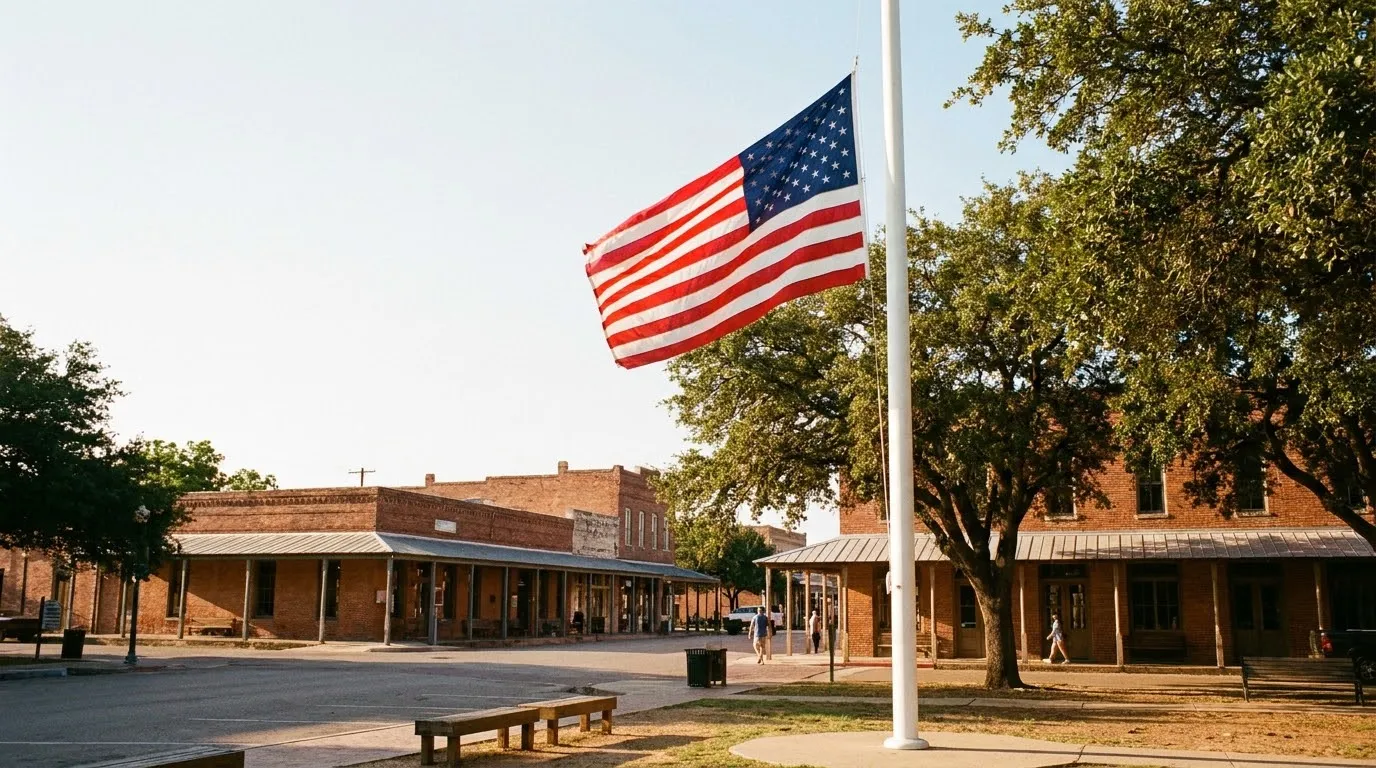
Under the United States Flag Code (4 U.S.C. § 6), citizens are encouraged to display the American flag on all days and especially on legal public holidays listed under 5 U.S.C. § 6103. Unlike Memorial Day or Patriot Day, Juneteenth is a celebratory holiday of freedom rather than a day of mourning, so the United States flag is flown at full-staff from sunrise to sunset. For full details on residential display, see our guide on flag etiquette.
Patriotic Apparel for Summer Civic Holidays
From June 14 through June 19 and into the first week of July, Americans attend outdoor parades, courthouse history readings, and backyard cookouts in warm summer weather.
If you are looking for comfortable, understated patriotic apparel to wear during June and July civic celebrations, our collections focus on timeless American symbols and constitutional heritage:
- Founding Document Designs: Our We the People collection highlights the enduring principles of constitutional government and liberty for all citizens.
- Classic Stars and Stripes: Breathable ring-spun cotton American flag shirts and embroidered American flag hats offer clean, well-proportioned designs suited for sunny afternoon parades and community picnics.
By studying the archival history of General Order No. 3, honoring the Union soldiers and newly freed citizens of 1865, and participating in community gatherings on June 19, Americans celebrate the ongoing fulfillment of the nation’s founding ideals.
Frequently asked questions
What does Juneteenth commemorate in American history?
Juneteenth commemorates June 19, 1865, the day Union Major General Gordon Granger issued General Order No. 3 in Galveston, Texas, a day after he and approximately two thousand federal troops arrived. That military order enforced the Emancipation Proclamation across Texas, the most remote state of the former Confederacy, bringing legal freedom to more than 250,000 enslaved Americans two and a half years after President Abraham Lincoln signed the proclamation.
When did Juneteenth become a federal holiday?
Juneteenth became the eleventh permanent federal legal public holiday on June 17, 2021, when Congress passed and the President signed the Juneteenth National Independence Day Act (Public Law 117-17). The legislation passed the Senate by unanimous consent and the House of Representatives by a bipartisan vote of 415 to 14, amending Title 5, Section 6103(a) of the United States Code.
What day of the week is Juneteenth in 2027?
In 2027, Juneteenth falls on Saturday, June 19, 2027. Because the statutory date lands on a Saturday, federal law under 5 U.S.C. § 6103(b) directs that federal employees with standard Monday-through-Friday schedules observe the holiday on the preceding Friday, June 18, 2027. Community festivals, parades, and historical ceremonies take place throughout the entire June 18 to June 20 weekend.
Why were enslaved people in Texas not freed when the Emancipation Proclamation was signed in 1863?
When President Abraham Lincoln issued the Emancipation Proclamation on January 1, 1863, it applied to territories in rebellion against the United States. In practice, enforcing the proclamation required the physical advance of Union forces. Because Texas lay at the western edge of the Confederacy and saw limited major Union military occupation during the war, slaveholders there continued enforcing bondage until General Granger arrived with federal troops in June 1865.
Where is the original copy of General Order No. 3 kept today?
The official handwritten record of General Order No. 3 is preserved at the National Archives Building in Washington, D.C. It is housed within Record Group 393, Part II, Entry 5543 (District of Texas, General Orders Issued), where the order was written in a bound volume beginning on one page and continuing to the next.
How is Juneteenth traditionally observed across the United States?
Americans observe Juneteenth through a blend of historical education, civic ceremony, faith gatherings, and community celebration. Longstanding traditions started by freedmen in Texas in 1866 include public readings of the Emancipation Proclamation and General Order No. 3, church services, parades, historical lectures, family cookouts, rodeos, and flying the United States flag to celebrate constitutional liberty.
Sources
- National Archives - The Original Juneteenth Document: General Order No. 3
- 5 U.S.C. 6103 - Holidays
- Public Law 117-17 - Juneteenth National Independence Day Act
- U.S. Office of Personnel Management - Federal Holidays
- Smithsonian National Museum of African American History and Culture - The Historical Legacy of Juneteenth